Blog Post: An Epidemic of Strapped Attention
Guest Post by Brayden Armes
We are currently facing an epidemic of strapped attention. Social media algorithms, the internet, and advertising are designed in such a way to pull our attention, and with AI powered algorithms they are only going to get better at curating our attention.
Imagine doom scrolling on Instagram. With one tap of minimal effort you open the app. You tap on your friends’ stories, and again and again to advance the slides. Then you begin swiping. With just the flick of your thumb you slide through posts. Your eyes dance from post to post in modern titillation. Then you look at the clock. It’s been an hour or two.
You feel gross. You reach for a rationale to justify your behavior. How did that happen so easily?
The social media system is designed to do just that. It takes advantage of desire and uses it to fuel what effort is needed to “pay attention”. “Attention” comes from the Latin roots meaning “to stretch” or “to extend”. The acknowledgement of attention as a thing that stretches has seeped into our nomenclature. We talk about “attention spans” and “giving our attention”. We also talk about a cost associated with our attention: we “pay attention”. Attending to something costs us. Sometimes that cost is worth paying– like in what you gain from reading. Sometimes that cost is not worth paying – like what you don’t get accomplished when you doom scroll on Instagram. In the former case of reading, the cost of paying attention includes effort on our part. We end up making an effort to read knowing that we want to want to read. With the latter case of Instagram any cost of effort is aroused by desire. Our feed supplies us with just the right amount of desire to keep scrolling. It stretches our attention at just the right rate to keep our thumbs flicking.
Think of attention in three ways: shallow attention, deep attention, and latent attention.
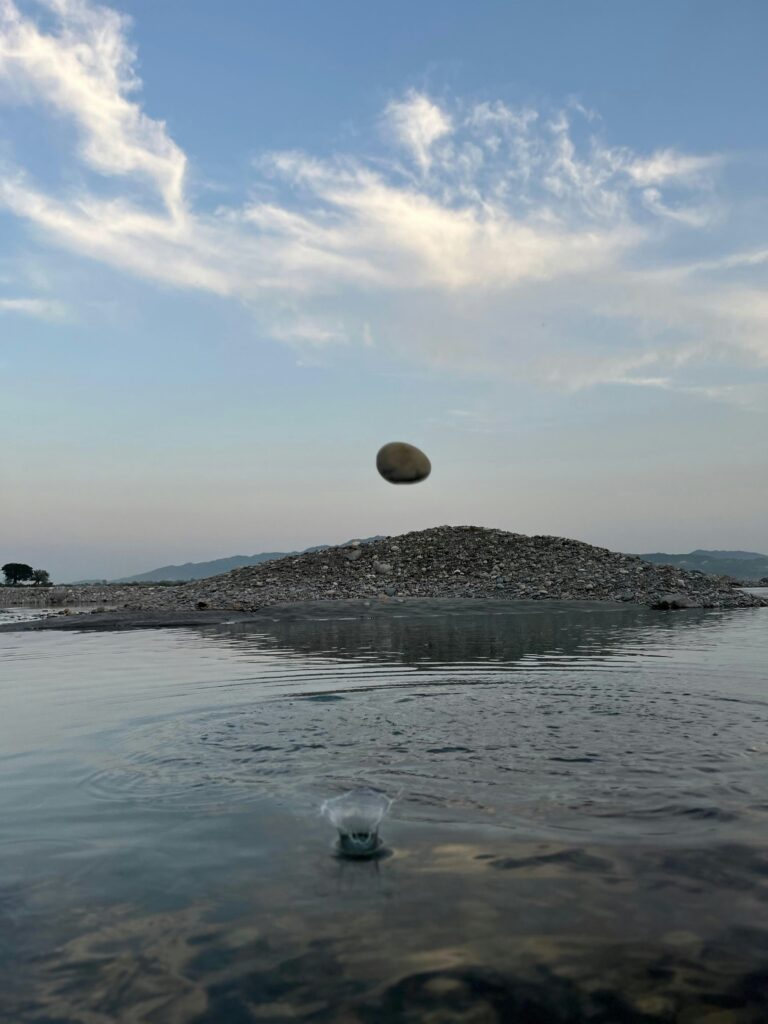
Shallow attention is when our attention is stretched like a skipping stone. It’s what happens when we scroll through social media.
Deep attention is like a sinking stone. It’s what happens when we enter a phase of deep work. We become like a free diver exploring beneath the surface of the water.
Latent attention is what happens when we are bored. We float on the surface, snorkel to observe underwater, or lay on our backs cloud watching in the water.
With all attention there is an object and duration. Attention stretches towards something for a time. A stone skips across the water heading towards the horizon…then sinks. A free diver explores life underwater…then resurfaces for air. Our minds wander from cloud…to cloud. There are some objects which aren’t particularly interesting that we end up paying the cost to attend to (like laundry). Other objects entice our desire and naturally grab our attention. Loud noises and bright colors make it easy to pay attention. This is how most of the systems we find ourselves immersed in are designed. From social media, to ads, to commercials, billboards, stoplights, webpages…the list goes on and on.
Our attention is stretched thin. We live in environments that foster shallow attention. We are at risk of becoming skipping stones and not free divers or cloud watchers.
Now you might say all this is fine (and perhaps you are right), but I’d like you to consider something. Attention is not just a resource. It can be a basic action. It plays a foundational role in how we learn and grow. We learned to raise our hands in class. We learned how to open doors. These are basic actions. By basic actions I mean you simply do them. You were likely taught how to raise your hand by someone raising their hand and saying, “Like this.” You learned how to open a door by watching and doing so. These basic actions you did and only eventually were you able to describe what happens when you do them: how the radial and ulnar bones form an “X” then move parallel, how the muscles in your arm and back cause your bones to bend and hand to lift.
If attention is a basic action and our environments are designed to foster shallow attention exclusively, then there are some modes of basic action we are not engaging in. AI promises to solve this problem for us by enabling us to do deep things by leveraging our shallow attention.
It will do this for us at the cost of us knowing ourselves. We will lose self-knowledge in this process since attention is a basic way of knowing our inner world and operating in this world. I learned how to open doors by attending to them. In doing so I also learned about my body and how it moves in the world. Our environment that fosters shallow attention fosters shallow knowledge. Again, this may be alright, but consider the definition of life “unto the age” according to Jesus: to know the Father, the only true God and Jesus Christ whom he sent. If attention can be a basic function of knowing and life unto the age is about knowing God we are in dire straits. By fostering environments that mainly cultivate shallow attention we are closing ourselves off from the full life Jesus promises.
Attention is one way we know unseen things, and as humans we live in two landscapes: the seen and the unseen. A seen environment of strapped attention is well poised to produce desire driven humans who live on one landscape and have only a shallow spirituality. Those shallow individuals will find it naturally difficult to know and live at a deep level.
This environmental problem is, in part, contributing to a growing generation of emerging adults who have to work against an environment that prevents a basic way of knowing. I believe that because of this we will likely see a reemergence of knowledge institutions that steward a traditional fatih since, in general, the attention of individuals is too stretched to maintain a deep faith in and of themselves. Traditional institutions are one way deep, multigenerational knowledge can be offloaded.
Pay attention to your attention
Here are two practical ways to grow in the awareness of your attention:
Find a favorite sitting place. Sit there on two different occasions. Journal about everything you notice around you. Compare your two journal entries.
The goal is to notice things you wouldn’t otherwise notice. Doing this with a friend will also help you to discover the shared world you live in. Attention is one way to connect with each other through our shared world, so a world strapped for attention is poised to be a lonely one.
Invite a friend over to take a walk. As you walk, broaden your attention to notice as much as you can– colors, temperature, movements, creatures, weather, light reflecting. After your walk, discuss together what you noticed.
This will enable you to notice the changing world. Attention is a fluid thing. By attending to the same space on multiple occasions, you’ll become aware of the softly (or rapidly) moving world around you.