Blog Post: After Evacuations Part Two
Chapter Four
Class Sponsors
At RVA each high school class had sponsors–staff members who worked with the class through the traditional activities that had become a part of their schooling. Ellen and I, along with six other staff members, became the sponsors for Jeff’s class.
The two biggest events were the Junior-Senior banquet and the Senior Sneak. The class could earn money to meet the expenses for their Sneak, which was usually a bus trip from Kijabe to Mombasa. They would book rooms in a hotel for a weekend enjoying the tourist activities of the city. Unforgettable activities like swimming in the Indian ocean, taking a Dhow out to Wasini Island, viewing the abundant colorful fish from a glass bottom boat, and eating fresh cooked crab on another island filled their weekend.
The Senior Store helped earn money for the Sneak. They made and sold dozens and dozens of hot donuts and treats to all those who came to the Saturday activities at RVA. The items offered and sold on Valentine’s Day also contributed to their fund. The class could offer a restaurant meal to staff and other invited missionaries to earn even more for their class trip.
When Juniors, the class created a banquet for the Senior Class, transforming their selected site into an environment limited only by their imaginations. They combined the skills of the members of their class, their sponsors, and many of the student’s parents.
Amy Schuit, the class president, no doubt led the class discussions where they dreamed up the theme. Osgiliath was the title of the banquet for Jeff’s junior year and he had been selected by his class as the practical designer and builder. I was delighted to be part of the project. Together we crafted a waterfall, through which the guests could view the formal table settings, along with a stream and a pond that enhanced the authenticity of the setting. The arched bridge over the stream became an ideal location to take pictures of the young couples. All of this was built in secrecy in Downing Hall. His mom, the cateress, with the help of many helpers, cooked and delivered the banquet dreamed up by the class. In their last year, Jeff’s class would be the honored guests at the banquet prepared by the now Junior class.
Chapter Five
BHB. Biblia Husema Broadcasting, in Kenya
We had evacuated the DRC in the midst of building the RTK radio studio and erecting the radio tower on Puu Hill. It didn’t take long to discover that Chris Mutai shared my burden for Christian broadcast radio. He had been trying to initiate Christian FM broadcasting in Kenya as we had done in Zaire. AIC already had a program on VOK, the official Voice of Kenya, and Chris had a God given radio voice that was easily recognizable. His hearty greeting, “Jambo Binadamu!” (hello sons of Adam) was already well known and he was recognized when we sought permission to broadcast for AIC. Mr. Mutai had received recording equipment from a large church in the States and had started building a radio studio at Kijabe.
His vision was to reach all of Kenya. I had seen broadcast coverage patterns generated by HCJB computers for different locations and tried to convince him that from Kijabe he would reach only the Maasai living in the Rift Valley. I wanted to convince him to seek permission to broadcast from Nairobi. The equipment he had in the partly built studio at Kijabe did not yet include a transmitter nor did he have an antenna.
Having been told to leave Rethy before the RTK radio studio, tower and antenna could be completed, that project in the DRC abruptly stopped. I never returned. The attacks of Lendu men, driving out the Alure and Hema peoples, became violent and villages were burned. The Lendu claimed that their land had been taken by these tribes. How was the land divided in the first place? The tribal conflicts escalated and we were told by the church and mission leadership to leave.
Chapter Six
Funds from RTK to BHB
At the time we evacuated, the RTK radio at Rethy was still broadcasting under the leadership of Mboligihe Ndalu, the Zande selected by CECA 20 to direct the radio work. He was using the equipment supplied by HCJB and broadcasting from a shipping container by the press where I had mounted the antenna at the top of a pine tree.
The new 110-foot radio tower on Puu hill only had one element of the four-bay antenna in place. While the permanent studio building had been constructed, there was more work to be done for the recording rooms. The equipment hadn’t yet been installed when we left and there was still money in the account dedicated to radio work.
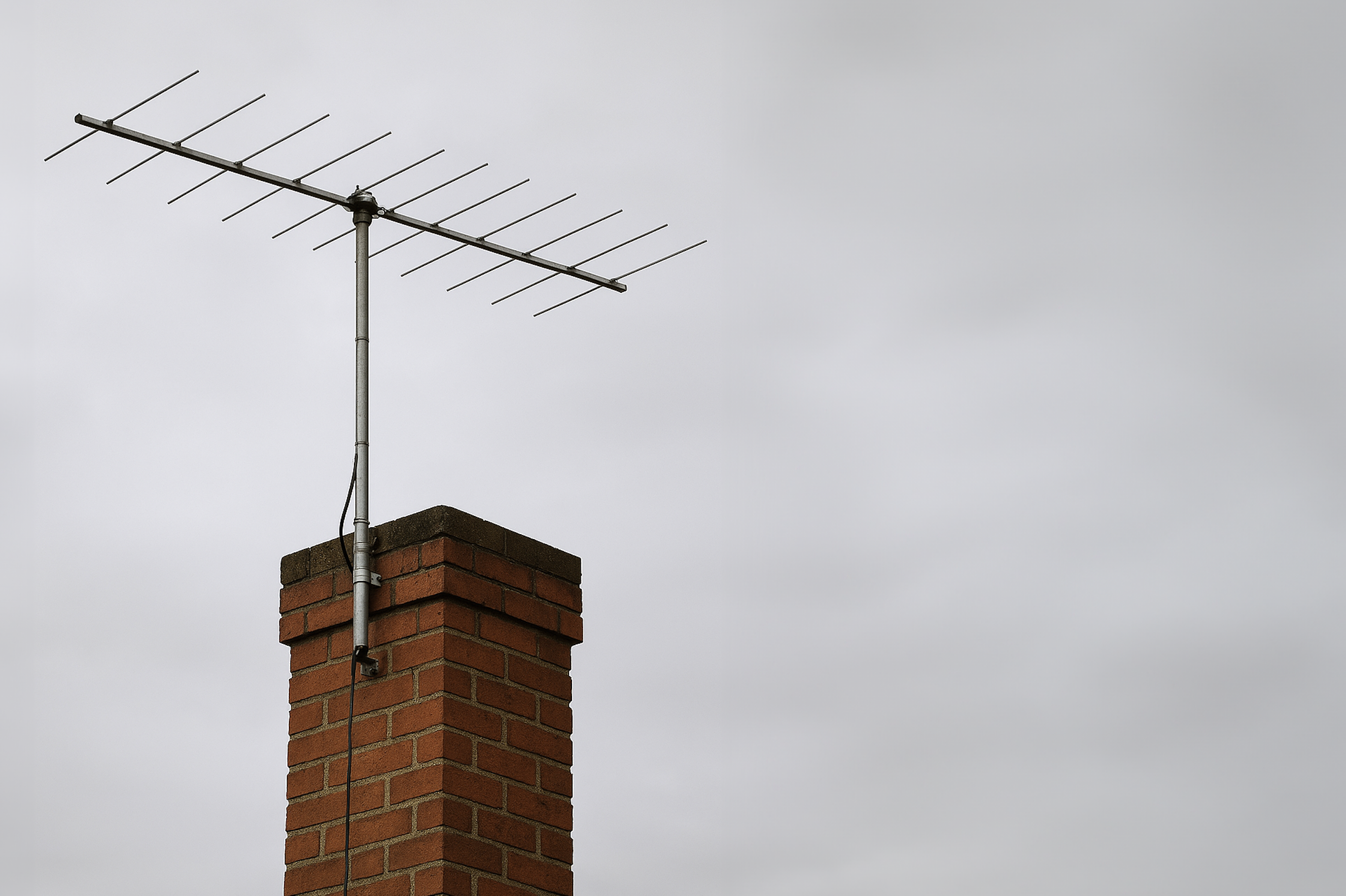
I communicated with the HCJB (now called Reach Beyond) representative, Ken Cummings, who had brought out the first suitcase radio station to Rethy. He asked if there was any additional thing he could bring for Ellen and I when he brought similar equipment to Kenya to initiate BHB broadcasting. All we could think of was a small, simple table alarm clock since we ran our last little clock through the wash with the bedsheets. He brought us a small plastic clock. When AIC received permission to broadcast, we set up the CD player and the transmitter in our upstairs bedroom at RVA. It was easy to run the coax cable out a window to the antenna. We strapped the mounting pipe for that antenna to the chimney of our house.
Much to the delight of many missionaries living and serving at Kijabe, this temporary broadcasting site played a variety of continuous Christian music. Certainly Chris Mutai and other AIC leaders at Kijabe now understood that although the FM signal was clear, it did not reach over the edge of the escarpment behind Kijabe. The broadcast coverage maps were now easy to understand. The music could not be heard at all in Nairobi where a very large AIC church was located. Kenya’s president, Daniel Arap Moi, was a member of that AIC church and it was his government that had approved the request for broadcasting. The bureaucratic approval process moved along quickly.
The AIC offices were on the side of a low hill on the West side of the city. A little further up the hill was a five-story office building. The top of that building would very significantly increase the coverage area. I had big ideas, but it was God’s work, not mine.
Titus Kivunzi, the AIC president, was a very godly, practical man. He and the leadership decided to permit me to move and reassemble the broadcasting equipment in the Nairobi AIC office. I chose the end room in the row of offices. I ran the coaxial cable out through the tile roof and up the long pipe mast I erected to hold the antenna. I soon had a 400-watt signal broadcasting out over the city. The possibility of using the mic to broadcast live existed, as did broadcasting pre-recorded material, but none had yet been prepared. We continued broadcasting an assortment of Christian music using the CD changer. AIC organized a committee to manage the radio with Mr. Cheleshau, the Kenya minister of tourism, as the chairman.
I was interested in promoting cooperation between TWR, Trans World Radio, and AIC since TWR had a functioning recording studio in Nairobi. I also wanted Roger Stole, a German radio man who had been running a Christian radio station in Tanzania, to become involved. We met with TWR. We were treated to an outside meal cooked on a charcoal blazer right in front of us. We had several meetings in the Intercontinental Hotel’s plush meeting rooms. Roger shared his ideas, but no working relationship was established. He was not invited to assist in the running of the radio broadcasting ministry.
About this time Silas Yego was selected to replace Titus Kivunzi as AIC president. The make-up of the radio committee was modified under the new leadership. Unfortunately, the 400-watt radio transmitting equipment was stolen from the temporary office location and while there were meetings convened to decide what to do next, I can’t recall any of the discussions. I was still involved in RVA and my input was not necessary or requested for AIC to move forward.
Kijabe was about 35 miles from Nairobi and when I learned that a new more powerful transmitter had just been imported, I took a trip into town to see what was happening. When I arrived at the office compound, I found the area to be guarded. There were several cars in the shady parking lot under the Jacaranda trees and I recognized the chairman’s Mercedes. A meeting was apparently in progress, so I sent word that I was there. I anticipated being invited to join the discussions. I sat down on the low wall to wait. It was a beautiful day and in the dappled shade, all was peaceful. I remember being a little surprised when I was not immediately invited to join them. After waiting for over an hour, I began thinking that maybe my input was not wanted or needed at all. I was never summoned to join them. After all, the equipment under discussion was not something that I had ordered. Why should I be involved at all? In Zaire, I was considered the “Bwana” who had all the answers. I had become proud.
I think I was forgiven because Chris Mutai later took me to Nairobi to see the new, more secure, location where they planned to install the new equipment. DIGUNA, a Christian German organization almost like another mission society, had provided materials and expertise to AIC. The church had added security around their office and the new steel door installed would certainly discourage any attempts to break into those rooms. Of course I had some ideas which I shared with Mr. Mutai.
I never did tune in to the BHB, Biblia Husema Broadcasting, frequency, but have since heard that BHB FM stations have sprung up in many places in Kenya. The nomads on the Northern Frontier are being reached through programming created by the church. God has blessed far beyond my limited vision in that remote place. I am thankful to have been available during the start-up of the Kenya BHB radio system, immediately after being asked to leave the RTK broadcasting effort in Zaire.
While I had left Zaire (now the DRC), God was not finished there. DIGUNA members moved back into the new DRC and worked with the CECA church to complete the installation at Rethy. There are now seven more RTK broadcasting locations operating in that country and Mboligihe is still involved.
God chose to bless both BHB and RTK and I am so glad to have played a part. When I got proud and thought I had all the best ideas, I was shown that I wasn’t needed. To think more highly of myself than I ought to is exactly what we have been told not to do, yet God still chose to use me. He promises wisdom when we ask in faith. God is the faithful one.
Chapter Seven
Leaving Kenya When Jeff Graduates
Our terms of service in Africa had been far from normal, so we made plans for furlough right after Jeff graduated from RVA. Jeff had been accepted for schooling at Houghton College which was the only college he applied to. He wasn’t at all surprised, after all, he said, “Why wouldn’t I be accepted, my sisters and brother all went there?”
After five years at RVA, Jeff now had many friends who were almost like family, most of whom had no place in America to call home. They would all shortly scatter to different countries and never see each other again. RVA recognized this and offered re-entry seminars so kids could deal with the many changes that had taken place in their home culture during the years they had been in Africa. It was easy for me to understand Jeff’s reaction when he said the adjustment would be no problem for him. He could remember exactly where he had driven his machete into a beam in the barn and knew it would be there when he returned.
Selection of the graduation speaker followed a time-honored tradition where eligible candidates, often the fathers of a graduating seniors, were nominated by the staff and the final selection done by the senior class.
I was selected and it became my responsibility to do the best I could to share something memorable with the senior class. From the chapel talks I had shared with them, (now compiled in a book called Grandpa Still Remembers) they all knew I was also an MK. I had been separated from the classmates I had grown up with in the dorm at Rethy Academy. I had even shared stories of my first girlfriends.
They all knew and loved Ellen, so I told them the importance of clinging to the values and commitment they had made to Jesus and to never let go! I spoke of the ring Ellen gave me and the faithfulness God showed to us again and again. That story can be found in God’s Calling: Mungu Anaweza. Ellen still prays for all those kids on our class sponsors list. The list is now worn out from her daily use since we left RVA, but she still adds details to it as she prays daily for them.
Chapter Eight
Leaving Kenya for Furlough in New York.
Although it was time to leave RVA, it wasn’t the end for us. Selling everything we had in Kenya was easy since a new pottery teacher, Mr. Rothfus, had just committed to serving at RVA and needed a residence. They took over our home in the same way we had done three years earlier from the Littles. Our neighbors, the Hendrix, wanted the Christmas tree we had so I simply carried it to them fully decorated.
Since Titchie Swat was closed at graduation time, the outside hall was a perfect location to display all the useful things we had left. We left instructions to any who might arrive at the display to take anything they wanted and to place whatever they wanted to pay in the open Blue Band tin supplied. We did take two special items back to the States with us: a bedside cupboard I had made of silver oak for Ellen and Jeff’s dog, named Koda.
When our flight landed in Albany, NY we were met by Ellen’s parents, her brother Paul and our neighbor, Gail Buel. It was a great welcome after the long flight. We had flown from Nairobi to Amsterdam and Amsterdam to JFK and now we were only an hour and a half away from home. All our luggage arrived with us except Jeff’s dog, Koda. Now what?